.JPG) We have returned from the wilds of Los Glaciares National Park in Southern Argentina to wish you all a Happy Thanksgiving. We hope you are all doing well, enjoying your loved ones, and having fun. We needed to stock up on supplies and are returning to the backcountry for a few more days. I'll post later about Tierra del Fuego, where we camped for a few nights, and Los Glaciares, which is the most stunning park I've ever been too. Until then, keep smiling!
We have returned from the wilds of Los Glaciares National Park in Southern Argentina to wish you all a Happy Thanksgiving. We hope you are all doing well, enjoying your loved ones, and having fun. We needed to stock up on supplies and are returning to the backcountry for a few more days. I'll post later about Tierra del Fuego, where we camped for a few nights, and Los Glaciares, which is the most stunning park I've ever been too. Until then, keep smiling!
26 November 2009
Happy Turkey Day
We have returned from the wilds of Los Glaciares National Park in Southern Argentina to wish you all a Happy Thanksgiving. We hope you are all doing well, enjoying your loved ones, and having fun. We needed to stock up on supplies and are returning to the backcountry for a few more days. I'll post later about Tierra del Fuego, where we camped for a few nights, and Los Glaciares, which is the most stunning park I've ever been too. Until then, keep smiling!
19 November 2009
Antarctica? Not This Time
How far are two people willing to go to find the best hot chocolate? Well, for us, we went to the end of the world. We also found a very cool city, big mountains, lots of snow, and an opportunity for further exploration.
K. and I had a month between our arrival and our parents' respective arrivals in Santiago, Chile. We decided to fly down to Southern Patagonia for some pre-season trekking. This area of the world is so far south that it's really only good for hiking during a few months. By coming early, we avoid the "crowds" and the higher prices. Additionally, it's sooooo far south that it'd take 60+ hours by bus from Santiago. While we will use buses for most of our South American adventure, a few choice flights will save us a lot of time and can actually save us money. Win, win, win.
K. and I had a month between our arrival and our parents' respective arrivals in Santiago, Chile. We decided to fly down to Southern Patagonia for some pre-season trekking. This area of the world is so far south that it's really only good for hiking during a few months. By coming early, we avoid the "crowds" and the higher prices. Additionally, it's sooooo far south that it'd take 60+ hours by bus from Santiago. While we will use buses for most of our South American adventure, a few choice flights will save us a lot of time and can actually save us money. Win, win, win.
To get to Southern Patagonia, we flew into Punta Arenas, Chile. Then we took a 12 hour bus-ride to Ushuaia, Argentina. This is the most southern city in the world. If you want to be picky, there is a small village slightly further south on an island. However, there is also a bar much further south at a Ukrainian Antarctic research station. Most importantly, there are a lot of great parks in this area of the world and we plan to do a bit of hiking in several of them.
First off, however, was a day of talking to travel agents. There had been two spots left on an 11-day cruise to Antarctica for $3000. That's a ton of money, yes, but they usually go for $6-8k. The next-best "last-minute" price is $4k. Well, we didn't get the super deal of $3k, so we decided forget about Antarctica for now. That's a lot of money that could see us through several months of more travelling. It is something we could do when we are older. And why is coming to Argentina a once-in-a-lifetime experience, like many people advised us? It was easy to get here, it wasn't that expensive, it's safe, it's cheaper than the US, and it's fun. So why wouldn't we come back?
That being said, Ushuaia is a fun town. It is sandwiched between giant snow-covered mountains and the ocean. It reminds me very much of other extreme-cold port towns that I've seen in Alaska, Finland, and Russia: a backbone of shipping, the new look of tourist pursuits, a few crazy outdoorsy types, and a lot of normal people providing services for them all.
The hostels here are a bit more expensive than we've seen elsewhere, but the market is reasonable and people are friendly. Most importantly, we have found a great bakery and the best chocolatier. I'm talking about two crepes (chocolate and dulce de leche), a handful of homemade chocolates, and delightful hot chocolate for a few bucks. Now let's go find ourselves some mountains.
 Ushuaia's port, where fishing ships, Antarctic cruises, and cargo boats hang out.
 A normal view from town. It's only 20 minutes to the mountains. Hmm, wish I had my skis. . .
17 November 2009
The Real Fun Begins
Something felt safe about Central America. It wasn't necessarily that the countries were safe or that we weren't taking risks and having fun. Rather, it was the innate feeling that we were still under the giant US umbrella. We weren't far from home and could return easily if we had to. The Yankee shadow looms long here.

Yesterday was K's birthday. Carlos' family gave her a rose from their garden and three bittersweet chocolate bars. K and I slept in, then spent a lazy day shopping, eating the richest chocolate cake we've ever had, and strolling around downtown Santiago. We ended up at a Vegetarian restaurant and shared a salad (still partially full from the cake!). It was a relaxed, fun day.
Tonight, we flight to Punta Arenas, which is in the far south of Patagonia. We'll spend a month there, hiking around Torres del Paine, Tierra del Fuego, Los Glaciares, and possibly Antarctica. Communication won't be consistent, but we'd love to hear everybody's Christmas plans. My mom and K's family will be visiting us here for two weeks. We plan to stay in Mendoza and Upsallata (Argentina) and Valparaiso (Chile).

[It feels like California: dry weather, snow-capped mountain top to the east, golden poppies, and man-altered rivers.]
This week we made the big jump to Santiago, Chile, which will be our base for exploring the continent for the foreseeable future. We've had the pleasure to reunite with an old friend from Davis, Carlos, who has been incredibly gracious, helpful, and welcoming. While he lived in Davis for less than a year, he's treating with a kindness usually reserved for lifelong friends. His family has been most welcoming as well.
Yesterday was K's birthday. Carlos' family gave her a rose from their garden and three bittersweet chocolate bars. K and I slept in, then spent a lazy day shopping, eating the richest chocolate cake we've ever had, and strolling around downtown Santiago. We ended up at a Vegetarian restaurant and shared a salad (still partially full from the cake!). It was a relaxed, fun day.
Tonight, we flight to Punta Arenas, which is in the far south of Patagonia. We'll spend a month there, hiking around Torres del Paine, Tierra del Fuego, Los Glaciares, and possibly Antarctica. Communication won't be consistent, but we'd love to hear everybody's Christmas plans. My mom and K's family will be visiting us here for two weeks. We plan to stay in Mendoza and Upsallata (Argentina) and Valparaiso (Chile).
[It feels like California: dry weather, snow-capped mountain top to the east, golden poppies, and man-altered rivers.]
13 November 2009
Costa Rica - Final Thoughts
Costa Rica is unlike its Central American brethren for one striking reason: it has no standing army. This means there have been no military coups, destructive civil wars, or much American meddling. Instead, it has poured its political power into the environment and the well-being of its citizens. What a novel concept.
Costa Rica is known for its vast and diverse parks, abundant wildlife and eco-tourism opportunities. Through personal experiences and conversations with locals, rangers, and visitors, I have come to the following conclusions.
Costa Rica has done:
- An excellent job promoting eco-tourism (Everybody KNOWS about Costa Ricas parks and adventure playgrounds, even if they haven't been here).
- An admirable job protecting these parks (While other countries were declaring war, Costa Rica was declaring new parks)
- A mediocre job in managing them (Bad communication with users, few educational/research opportunities, very expensive user fees, no maps, generally horrible trail conditions, no websites)
- A poor job in protecting the area around the parks (Complete lack of planning has led to huge hotels built right on the park borders, no buffer parks, unhealthy activities like ATV, roads, and logging). This last point is particularly poignent because many people are now claiming that "eco-tourism" is actually ruining the environment.
Overall, we really liked Costa Rica. The food was good (not great). Prices here were more expensive than anywhere else, but we still never paid more than $10 for a bus ticket or $20 for a private double room. Plus, we were able to camp more (free!) and we didn't need to hire "guides" for safety. Parks were empty (and sometimes closed) because we went in the off season. We didn't feel insecure or trapped, and people were very friendly. We could drink water from the tap and eat the fruits and veggies.
Finally, we had a fantastic time with our friend from Davis, Carlos, who hosted us in San Jose. His family made us feel at home, didn't make us feel weird when we were forced to do weird things to get rid of bed bugs, and invited us to a giant family gathering where we ate well and played games. His mom is thoroughly an excellent cook.
Finally, we had a fantastic time with our friend from Davis, Carlos, who hosted us in San Jose. His family made us feel at home, didn't make us feel weird when we were forced to do weird things to get rid of bed bugs, and invited us to a giant family gathering where we ate well and played games. His mom is thoroughly an excellent cook.
The question that nags us is: What exactly is eco-tourism? How do you know if the place you give your money to actually follows said practices? When does your visitation actually bring more harm than good? Please share your thoughts via Comments. Thanks!
11 November 2009
Nicaragua
Without having much time to spend, K. and I focused our Nicaraguan travels on the most spectacular natural wonder: the Isla de Ometepe. This island is composed of two volcanoes around 1500m tall, one of which is still active. The tops of the volcanoes are usually covered with clouds. We hiked to the top of Volcano Meridan because it has lush cloudforest covering, more wildlife, and a lake at the top. Despite view-blocking clouds, the hike was terrific.
We stayed at a very interesting place: a Sandista-built organic coffee/cacao co-operative. How heavenly! History, politics, nature and chocolate in one place! The coffee/cacao operations are still running strong, while us backpackers occupied a side building that used to be used for housing workers. Conditions were less than desirable, but we only paid $8/night for a private "matrimonial" room and the grounds/gardens were quite tranquil.
Going to Nicaragua was a reminder of our times in Guatemala: a formerly war-torn country trying to recover and limit violence, little industrial base, cheap prices and good local food, efficient and cheap chicken buses, and friendly people (even if we were a little more guarded). Nicaragua seems to be more politically active/aware, with everything from huge political banners to "revolucion" still spray painted everywhere.
Nicaragua is the largest of Central American countries. Like almost every other country, it has a sordid relationship with the US. This story is probably more well known as it led to the infamous Iran-Contra Affair , in which Oliver North
 took the fall for Reagan.In short, we supported anti-Sandista factions in exchange for them supplying Iranian extremists with weapons, which we were legally unable to do. Hmm, I guess Bush did study history. What is less well-known is that my first kiss was with Oliver North's daughter. Never mind that we were in pre-school, it was still big news.
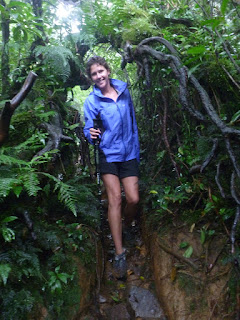
 The crater lake and views were obstructed by the clouds that typically sit on top of the volcano. But hey, we had the place to ourselves!


We stayed at a very interesting place: a Sandista-built organic coffee/cacao co-operative. How heavenly! History, politics, nature and chocolate in one place! The coffee/cacao operations are still running strong, while us backpackers occupied a side building that used to be used for housing workers. Conditions were less than desirable, but we only paid $8/night for a private "matrimonial" room and the grounds/gardens were quite tranquil.
Going to Nicaragua was a reminder of our times in Guatemala: a formerly war-torn country trying to recover and limit violence, little industrial base, cheap prices and good local food, efficient and cheap chicken buses, and friendly people (even if we were a little more guarded). Nicaragua seems to be more politically active/aware, with everything from huge political banners to "revolucion" still spray painted everywhere.
Nicaragua is the largest of Central American countries. Like almost every other country, it has a sordid relationship with the US. This story is probably more well known as it led to the infamous Iran-Contra Affair
, in which Oliver North took the fall for Reagan.In short, we supported anti-Sandista factions in exchange for them supplying Iranian extremists with weapons, which we were legally unable to do. Hmm, I guess Bush did study history. What is less well-known is that my first kiss was with Oliver North's daughter. Never mind that we were in pre-school, it was still big news.The hike through the cloud forest was fantastic. Dense growth, dwarf trees, gnarly trail...
The view from our "rustic" dwelling place - Finca Magdalena.
Rigid bike on old dirt road, bad brakes, three speeds if you're lucky, balloon tires, jeans and a tank top - what is this, Marin County 1979?
Art on the wall of our open-air ramshackle of a home. Loads of history and character.
04 November 2009
And Now For Something Completely Different
 While still in Costa Rica, we feel like we´re in a different world. We´ve made our way north to the touristy beach area of Tamarindo. It´s not just the numerous gringos, the over-abundande of surf bums, or the higher costs that make this different. We are lucky enough to have some family here too - Chris (my bro), Hillary (my sister-in-law) and Mia (my niece!) - plus we are staying at a real hotel and eating fancy foods. What has become of us?!
Of course it´s been really great time to spend time with fam. We are very honored to have our first "visitors" so soon. We spend our days eating well, reading, surfing, hiking, playing cards, and playing with Mia. It is difficult for me to see my first niece and know that it will be another 1-2 years before I see her again. Mia won´t remember these two years apart, but the rest of us "adults" will.
 The week flew by too quickly and everybody was sad to depart. K. and I extended our beach stay by moving 20km north to Flamingo. My uncle Buddy put us up in his favorite hotel for two nights. My uncle Bob and aunt Julie sent us on a jungle canopy tour, whizzing through the trees on zip lines up to 1/2 km long. Thanks for the fun wedding presents!
This part of our trip was extra special because it was the closest thing to a traditional honeymoon. After we got married, we spent several days in San Francisco with K´s family. Then we took off for our 2 week roadtrip through the northwest. Eventually we embarked on this journey. All three trips have been fantastic, but none of them were exactly relaxing. We have been doing a lot of hiking, camping, cooking, and staying in cheap places. This last week was a great change of pace.
Now we return to our regular programming. Next up: Nicaragua.

Chris tried to teach us all to surf.

I could stand on the surfboard for about 3 second. Credit to Kristin for snapping a picture in such a short time frame.

Kristin zipping through the dense forest.
Subscribe to:
Posts (Atom)